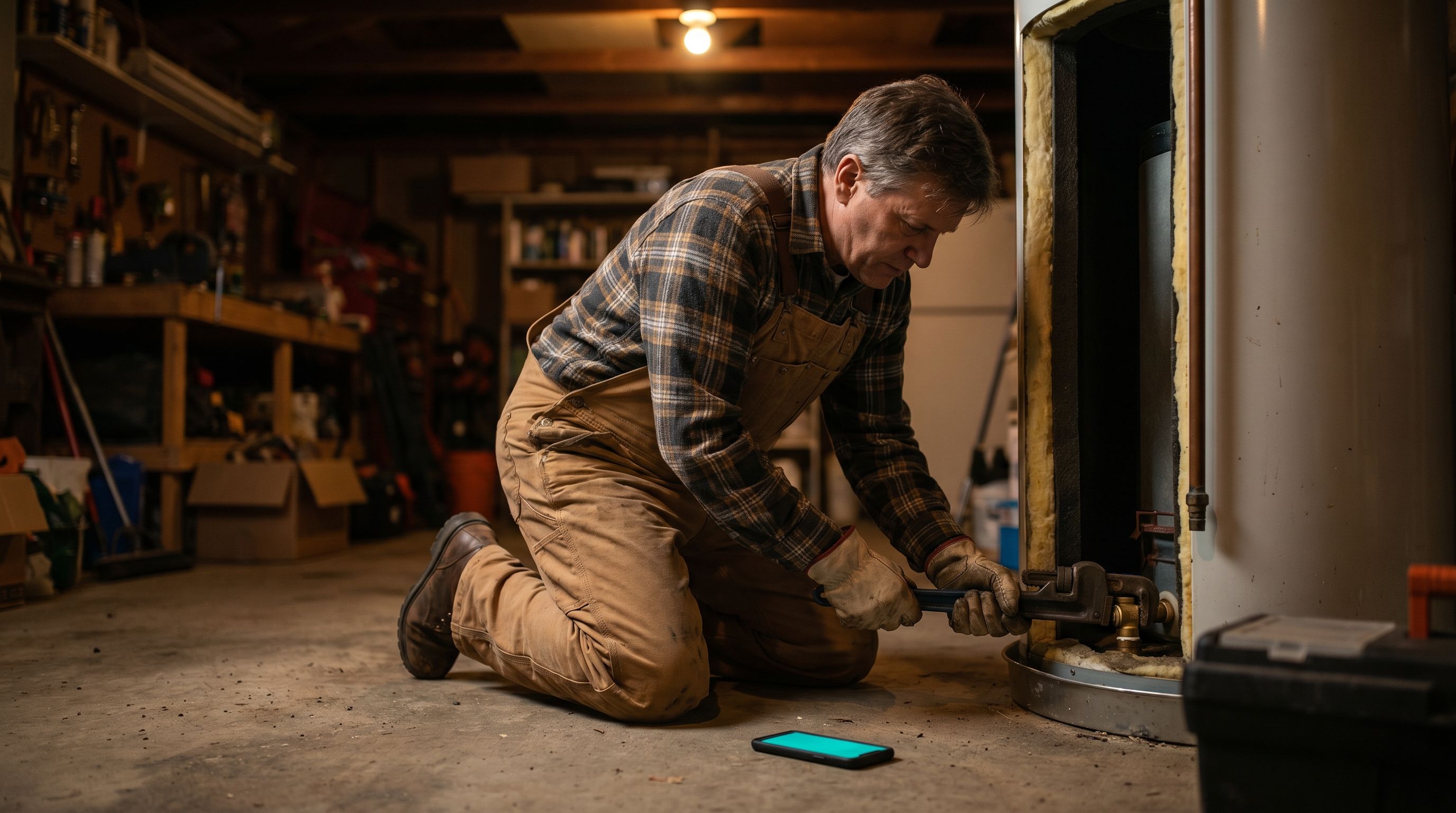
It's 6:15pm on a Thursday. Your office closed 15 minutes ago. The last tech is loading the van. Between now and 9pm, three calls come in. All three are homeowners with a problem they want solved this week — a water heater that's making noise, an AC that quit in the heat, a leak they just noticed under the sink. None of them leave a voicemail.
Two of them call the next company on the search results page. One tries you again tomorrow, maybe.
That's not a hypothetical. That's Thursday.
The after-hours window is bigger than you think
Somewhere between 34% and 42% of service business inquiries arrive outside the standard 9-to-5 window, according to industry data. For home services and healthcare specifically, that number skews higher — people don't stop noticing a broken pipe or a chest pain because it's after dinner.
Here's the part that matters more than the percentage: evening callers tend to be your most motivated leads. They've been dealing with the problem all day — thinking about it during the commute, noticing it again after work, finally getting a quiet minute to pick up the phone once the kids are fed. By the time they call at 7pm, they've already decided to hire someone. They're not comparison shopping five companies. They're trying to find the first one that answers.
Weekend mornings work the same way. Saturday at 8am, before the errands start, is prime time for exactly the kind of call that turns into a booked job by Monday — if someone's there to take it.
Think about your own last few days off. When did you actually deal with the stuff you'd been putting off — the insurance call, the dentist appointment, the quote for the fence? Probably not during your own work hours. Probably evenings and weekends, in the gaps between everything else. Your customers run the same schedule. The office hours that work for your team don't line up with the hours your customers have free to make a decision.
What happens to those calls
If nobody answers, the call goes to voicemail. Then the math turns against you fast.
85% of callers who hit voicemail simply don't call back, according to Invoca's 2023 research. They don't leave a message and wait. They move to the next result.
And that next call happens quickly. Industry aggregates put it at 67% of callers reaching out to a competitor within five minutes of not getting through to the first company. Five minutes. Not five hours. HubSpot's research backs this up from the other direction — callers expect a pickup within three rings, full stop, regardless of what time it is.
So the sequence looks like this: phone rings after hours, nobody's there, voicemail picks up, caller hangs up, caller searches again, caller calls whoever answers next. The whole thing takes less time than it took you to read this paragraph.
None of this is the caller being flaky or disloyal. They have a leak. They want it handled. If your voicemail greeting is the only thing they get, you've told them, functionally, to go find someone else — even though that's not what you meant to say.
The math on what this actually costs
Say you're getting 30 calls a week. If 35% of those land after 5pm or on weekends, that's roughly 10 after-hours calls a week — about 520 a year.
Apply the 62% miss rate that BrightLocal found across home-service call answering in 2024, and you're missing around 320 of those 520 calls annually. At an average job value of $350, that's over $110,000 in potential revenue that never reaches your calendar — not because you lost the bid, but because nobody picked up the phone.
Run your own numbers on this at /tools/missed-call-calculator. Most owners are surprised by where the number lands. It's rarely a small one.
And that $110,000 figure is conservative. It assumes your after-hours share sits at 35% and your average ticket holds at $350 — plenty of trades run higher on both. Emergency plumbing and HVAC calls that come in at 9pm tend to skew toward bigger jobs, not smaller ones, because by the time someone's calling that late, the problem has usually gotten worse, not better.
Your options for covering after-hours
Hire night or weekend staff. Technically the most "complete" fix. Also expensive and hard to justify when the call volume during those hours doesn't fill a full shift. You're paying someone to sit by a phone that rings ten times a week.
Use a traditional answering service. Better than nothing. A person picks up, takes a message, tells the caller you'll get back to them. But that's still a callback the next morning — and the caller who wanted same-day service already booked with someone else by then. You've moved the missed-call problem from "no answer" to "delayed answer," which helps, but doesn't close the gap that actually matters.
Use an AI receptionist that books the job on the spot. This is the difference that changes the outcome. Instead of taking a message, the call gets answered, the caller's problem gets addressed, and an appointment gets booked — at 9pm on a Thursday, same as at 9am on a Tuesday. No callback required. No cost per minute. Flat rate.
How DoubleXL Answer handles it
DoubleXL Answer picks up every call the same way, day or night — first ring, every time, 365 days a year. It doesn't get tired at 8pm or distracted during a Saturday rush. It asks the right questions, gets the job details, and books directly into your calendar.
You get a text with the details the moment the call ends. No sorting through voicemails at 7am trying to figure out what three different people wanted. You wake up to a schedule that already has Thursday night's calls on it.
There's no per-minute billing and no surprise invoice after a busy weekend. It's a flat $99/mo, whether you get five after-hours calls that week or fifty.
Setup takes a few minutes, not a few weeks. You're not writing a training manual for a night shift or interviewing candidates for a role that only makes sense on paper. You connect your existing number, tell the system how you want jobs booked, and it's answering calls that same evening.
If you're running a lean team — which is most home service businesses — this is the gap that costs the most and gets fixed the fastest. See how it fits alongside the rest of your team's workflow at /workforce-ai.
FAQ
What percentage of calls come in after business hours?
Industry data puts it at 34-42% across service businesses generally, with home services and healthcare often on the higher end of that range. If you're not tracking this for your own business, it's worth pulling your call logs for a week — most owners underestimate it.
Do I need to be available when the AI answers?
No. That's the point. DoubleXL Answer handles the call independently — takes the details, answers common questions, books the appointment — and sends you a summary afterward. You don't need to be reachable at 9pm for the system to work.
Is there an extra charge for nights and weekends?
No. Plans start at $99/mo flat, and that covers calls at any hour, any day. No per-minute fees, no after-hours surcharge, no separate weekend rate.
Reach out at hello@double-xl.com or +1 (385) 396-4901, or set it up directly at try.double-xl.com.